Hail & Wind Storms in Aurora, IL — Latest Dates and Sizes
Hail and wind activity within ~25 miles of Aurora, Illinois or recorded for its county: the last 12 months from NWS warnings, storm reports, and station measurements, plus official NOAA records back to 2010.
Latest hail and wind near Aurora
- Last reported hail (0.75 in.+, screening): August 21, 2026 — 1.00 in. reported 23.6 mi NW of Aurora (3 E Sycamore), SPC storm report.
- Last wind gust 45 mph+ (screening): August 12, 2026 — 64 mph reported 15.3 mi S of Aurora (2 NNW Shorewood), SPC storm report.
- 2026 so far: 11 hail days and 21 wind days within 25 miles (days with a storm report or station gust at the screening thresholds; warnings alone never count).
| Date | Largest reported hail | Strongest gust |
|---|---|---|
| August 21, 2026 | 1.00 in. reported | — |
| August 12, 2026 | — | 64 mph reported |
| August 11, 2026 | — | 97 mph reported |
| August 9, 2026 | 1.00 in. reported | — |
| July 28, 2026 | 2.00 in. reported | — |
| July 27, 2026 | 3.00 in. reported | 78 mph reported |
| July 4, 2026 | — | 68 mph reported |
| July 3, 2026 | 1.00 in. reported | 63 mph reported |
| July 2, 2026 | — | 66 mph reported |
| June 24, 2026 | — | 58 mph reported |
Was your address hit on August 21, 2026? Check any address free with the Free Report Snapshot — a YES/NO estimate at the screening thresholds.
Aurora storm facts
- StormAuditor's analysis of NOAA and National Weather Service records found 312 wind and hail events, NWS warning products included, within 25 miles of Aurora, Illinois or recorded for Kane County in the 12 months ending October 7, 2026 (149 wind, 163 hail).
- The strongest gust within 25 miles of Aurora in the last 12 months was 97 mph, reported 7.8 mi W of Aurora (1 SE Sugar Grove) on August 11, 2026 (SPC storm report; storm reports and station gusts only, warnings excluded).
- The largest hail reported within 25 miles of Aurora in the last 12 months was 4.80 in., 16.5 mi E of Aurora (Darien) on March 10, 2026 (NWS Local Storm Report).
- The busiest day by event count near Aurora was July 27, 2026, with 58 events.
- Kane County alone recorded 93 of those wind and hail events (55 wind, 38 hail); the Illinois page ranks counties by events of every type, floods and Special Weather Statements included.
Aurora, Illinois storm history at a glance (last 12 months)
This free weather history for Aurora — home to about 180,000 residents — draws on StormAuditor's consolidated public record: 312 wind and hail events within 25 miles of Aurora or recorded for Kane County in the trailing 12 months — 149 wind and 163 hail.
Events combine NWS warning products, observed Local Storm Reports, station measurements and official NCEI records in one event table. Because they include warnings, and wind covers thunderstorm and non-thunderstorm wind alike, they measure something different from the NCEI entry counts in the history section below; the two are not comparable year to year.
Busiest days near Aurora by event count
Ranked by the number of 12-month events, NWS warnings included, so a day with many warnings can outrank a day with larger hail.
- July 27, 2026 — 58 events incl. warnings · 15 wind · 43 hail · storm-date page: 52 storm reports
- March 10, 2026 — 45 events incl. warnings · 1 wind · 44 hail · storm-date page: 44 storm reports
- March 30, 2026 — 30 events incl. warnings · 1 wind · 29 hail
- August 11, 2026 — 22 events incl. warnings · 21 wind · 1 hail · storm-date page: 16 storm reports
- June 10, 2026 — 17 events incl. warnings · 16 wind · 1 hail
Storm-day records for Aurora
Storm-date pages for the biggest days near Aurora: a report or station gust within 25 miles met NWS severe criteria (hail 1.00 in.+ or wind 58 mph+), with at least two separate observations. Not every storm day in the table above has a page. Each page lists the reports, station gusts and a free way to check one address:
- August 11, 2026 (gusts 97 mph)
- July 27, 2026 (hail 3.00 in., gusts 78 mph)
- March 10, 2026 (hail 4.80 in.)
How these numbers are counted
The storm numbers on this page are counted in four different ways, plus the free address check. Each answers a different question with its own size cutoffs, area and time span, so compare numbers within one group, not across groups.
- Storm days (latest hail and wind): A day in the last 12 months when at least one report within 25 miles of Aurora showed hail 0.75 in. or larger or wind of 45 mph or more (StormAuditor screening thresholds). Reports are NWS storm reports from spotters, the public and officials, plus weather-station gusts, which count from 50 mph. A warning on its own never makes a storm day. The latest and largest hail, the latest and strongest gust, and the storm-day table all use this record.
- Storm-date pages (NWS severe): A storm-date page is published only when at least one report or station gust within 25 miles of a city met the National Weather Service severe criteria (hail 1.00 in. or larger, or wind 58 mph or more), at least two separate observations were logged, and the day ranks among the most significant. A storm report that relays an airport weather station's reading (the same station, the same gust and the same time) counts once, as the station reading. Not every storm day gets a page; when one does, the page and the storm-day table show the same largest hail and strongest gust.
- Events (12-month counts): Events count NWS warnings, storm reports (wind 50 mph+, hail 0.75 in.+), station gusts (50 mph+) and NCEI entries within 25 miles of Aurora or recorded for Kane County, tornado entries counted as wind. One event is one place on one day, counted separately for hail and for wind. A weather station or storm-report point counts once a day, at that day's highest reading, however many readings it filed; a place with hail and wind on the same day is two events. NWS warnings count once per county per day, and each NCEI entry once per place per day. A storm report that relays an airport weather station's reading (the same station, the same gust and the same time) counts once, as the station reading. The same report arriving through another feed (SPC or NCEI) is one record. Events measure how busy the area was, not whether a storm hit: one storm can bring warnings and reports from many places, so the busiest days by event count can differ from the storm days.
- NOAA history (since 2010): The official NOAA storm record (NCEI Storm Events) within 25 miles of Aurora or in Kane County from January 1, 2010 to the day before the 12-month window starts: hail 0.50 in.+, thunderstorm wind 40 mph+ and tornadoes. It is a separate, older record with its own "storm days" (days with any entry), so its counts are not compared with the 12-month numbers.
- Free Report Snapshot: A free YES/NO estimate for one address, from radar and wind analysis at the property rather than area reports, at the same screening thresholds: hail 0.75 in. or wind 45 mph.
Full method: Methodology and Data Sources.
Aurora hail and wind history in NOAA NCEI records, 2010–Oct. 2025
This section covers January 1, 2010 through October 6, 2025. Storms from October 7, 2025 on are in the 12-month summary above, so no date is counted in both.
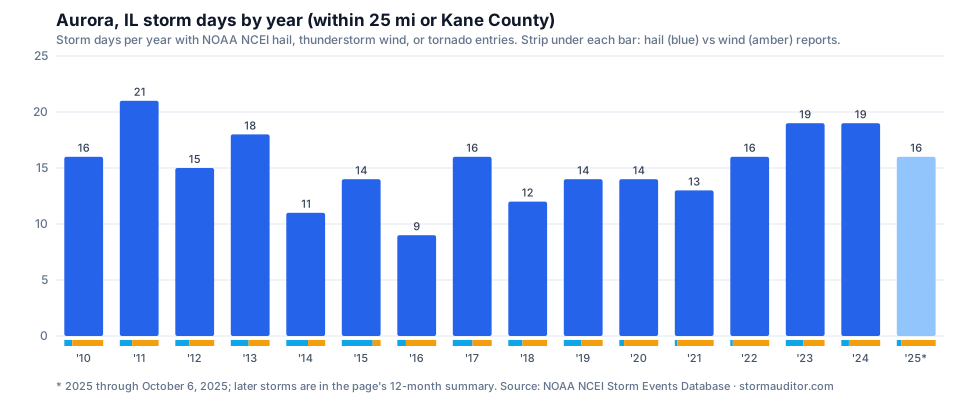
The National Centers for Environmental Information logged 243 storm days within 25 miles of Aurora or in Kane County in this period — 1,806 NCEI Storm Events entries in all. Thunderstorm wind outnumbers hail about 2.5 to 1 here: 1,219 wind reports against 480 hail reports.
On June 10, 2015, 4.75 in. (larger than softball size) hail was reported in Kendall County — the largest in these records for this area. Hail of 2 inches or more appears in 7 different years of this record, the latest being 2025 through Oct. 6. The strongest measured thunderstorm gust was 92 mph on June 29, 2012 in Kendall County. NCEI also lists 107 tornado entries for the area — one entry per county a tornado crossed.
Hail peaks in April (26% of all hail reports), while thunderstorm wind reports cluster in July. December through February accounts for 10 storm days.
The most storm days came in 2011, with 21; the fewest in a full year was 9, in 2016. Across 2022–2024, the area averaged 18 storm days a year, above the 15-year average of 15.
- Average: 15 storm days a year (2010–2024)
- April and June: 48% of all hail reports
- Most hail reports in one year: 78 in 2023
- Hail of 1 in. or larger reported in every full year, 2010–2024
| Year | Hail reports | Thunderstorm wind reports | Tornado entries | Storm days | Largest hail | Strongest measured gust |
|---|---|---|---|---|---|---|
| 2010 | 29 | 113 | 1 | 16 | 1.75 in. | 83 mph |
| 2011 | 39 | 83 | 1 | 21 | 1.75 in. | 71 mph |
| 2012 | 31 | 56 | 0 | 15 | 1.50 in. | 92 mph |
| 2013 | 44 | 52 | 0 | 18 | 2.00 in. | 70 mph |
| 2014 | 29 | 23 | 3 | 11 | 2.00 in. | 77 mph |
| 2015 | 39 | 10 | 3 | 14 | 4.75 in. | 61 mph |
| 2016 | 4 | 14 | 0 | 9 | 1.00 in. | 64 mph |
| 2017 | 43 | 42 | 0 | 16 | 1.75 in. | 78 mph |
| 2018 | 15 | 26 | 1 | 12 | 1.50 in. | 63 mph |
| 2019 | 38 | 47 | 2 | 14 | 2.25 in. | 60 mph |
| 2020 | 14 | 100 | 12 | 14 | 1.50 in. | 71 mph |
| 2021 | 7 | 98 | 9 | 13 | 1.25 in. | 74 mph |
| 2022 | 8 | 114 | 9 | 16 | 1.50 in. | 81 mph |
| 2023 | 78 | 95 | 31 | 19 | 3.00 in. | 81 mph |
| 2024 | 35 | 143 | 32 | 19 | 2.50 in. | 74 mph |
| 2025 through Oct. 6 | 27 | 203 | 3 | 16 | 2.50 in. | 83 mph |
Download this history: CSV · JSON at https://www.stormauditor.com/downloads/storm-history/il/aurora.json (free, open license, cite StormAuditor).
Source: NOAA NCEI Storm Events Database (thunderstorm wind, hail, and tornado entries; hail 0.50 in. or larger, wind 40 mph or more; wind converted from knots).
Aurora storm history questions, 2010–Oct. 2025
How big did hail get in Aurora, 2010–Oct. 2025?
4.75 in., larger than softball size, reported on June 10, 2015 in Kendall County, per NCEI. Hail of 2 inches or more appears in 7 years of this record in all, most recently 2023, 2024 and 2025 through Oct. 6.
Which year had the most storm days near Aurora, 2010–Oct. 2025?
2011, with 21 storm days (39 hail reports, 83 thunderstorm wind reports, 1 tornado entry). The 15-year average is 15 storm days.
How many hail reports does Aurora see in a typical year?
About 30 hail reports a year (2010–2024 average), with 1-inch or larger hail reported every year. Thunderstorm wind averages 68 reports a year.
What month has the most hail near Aurora?
April has the most hail reports (127, 2010–Oct. 2025), followed by June (101) and May (74).
What is the strongest measured thunderstorm gust near Aurora, 2010–Oct. 2025?
92 mph, measured on June 29, 2012 in Kendall County. Only gusts NCEI lists as measured count here; gusts measured on a date and county with a tornado entry, and entries of 120 knots or more (known entry errors), are left out.
Aurora hail map and wind map
Researching hail or wind in Aurora? The Hail Explorer and Wind Explorer map radar-derived hail swaths and peak-gust wind swaths across Illinois, including the Aurora metro: pick any storm date and see how estimated hail size and gust bands tracked through Kane County. Both explorers are included with Pro+ and Organization plans.
County-level activity is on the Impact Heatmap (free with an account), and day-by-day history is on the Storm Calendar (Pro plans and higher).
Free Aurora weather report by address
Area maps show where storms tracked; an insurance claim or roof inspection turns on what happened at the property. Three ways to check one Aurora address:
- The Free Report Snapshot answers YES/NO instantly on estimated wind of 45 mph or more and hail of 0.75 in. or larger (screening thresholds) at the address.
- The free Address Lookup lists NWS warnings, storm reports and NOAA observations near the address — free Aurora wind history and free Aurora hail history.
- A complete Weather Report for $2.99 covers every qualifying storm date at one address over the last 2 years.
All values are estimates from public NOAA data under our published methodology (see Limitations).
Storm professionals: restoration and exterior contractors, public adjusters, and crews and teams on one Organization plan work from this same public record — see StormAuditor for professionals.
Sources: NWS alerts (api.weather.gov) · NWS Local Storm Reports via the Iowa Environmental Mesonet · ASOS/AWOS station gusts via the Iowa Environmental Mesonet · NOAA NCEI Storm Events Database · every StormAuditor data source.
Free Aurora storm data download
The Aurora storm records for the last 12 months download free, free to reuse under the data license: download CSV · JSON at https://www.stormauditor.com/downloads/storm-data/il/aurora.json.
- Coverage: every wind and hail record within about 25 miles of Aurora or recorded for Kane County, with dates, counties, event types, measured gusts and hail sizes.
- Rows: each source record before consolidation, including every NWS warning product and smaller storm reports, so the row count differs from the event counts above.
- Statewide files are on the Illinois storm data page.
Nearby city storm pages:
- Naperville hail & wind history
- Joliet hail & wind history
- Elgin hail & wind history
- Schaumburg hail & wind history
- Cicero hail & wind history
- Arlington Heights hail & wind history
- Illinois statewide storm data
Guides for reading this data
Cite or link to this data — free
Free to quote, summarize, reuse, and link — for bloggers, journalists, researchers, contractors, and AI writing tools. No permission or credit required. A ready-made citation and link are below if they help. Terms: StormAuditor data & content license.
Citation: StormAuditor. "Aurora, IL Hail & Wind Storm History." Updated August 21, 2026. https://www.stormauditor.com/storm-data/il/aurora
HTML link: <a href="https://www.stormauditor.com/storm-data/il/aurora">Aurora, IL Hail & Wind Storm History — StormAuditor</a>
About this page: built by Storm Auditor LLC from public NOAA/NWS records — deduplicated warnings, storm reports, station measurements, and official records on a rolling 12-month window, under the published methodology. See the StormAuditor Editorial Team for how content is produced.
Data last refreshed October 7, 2026. Event counts cover wind and hail (warning products, and storm reports from 50 mph or 0.75 in.); flood activity and Special Weather Statements are not counted here.