Hail Size Chart: Understanding Roof Damage
By StormAuditor Editorial Team · Published 2026-07-23 · Updated 2026-10-07
Based on public NOAA and National Weather Service records, published under StormAuditor's methodology and data-source standards. Radar-derived hail sizes are estimates unless attributed to a ground report.
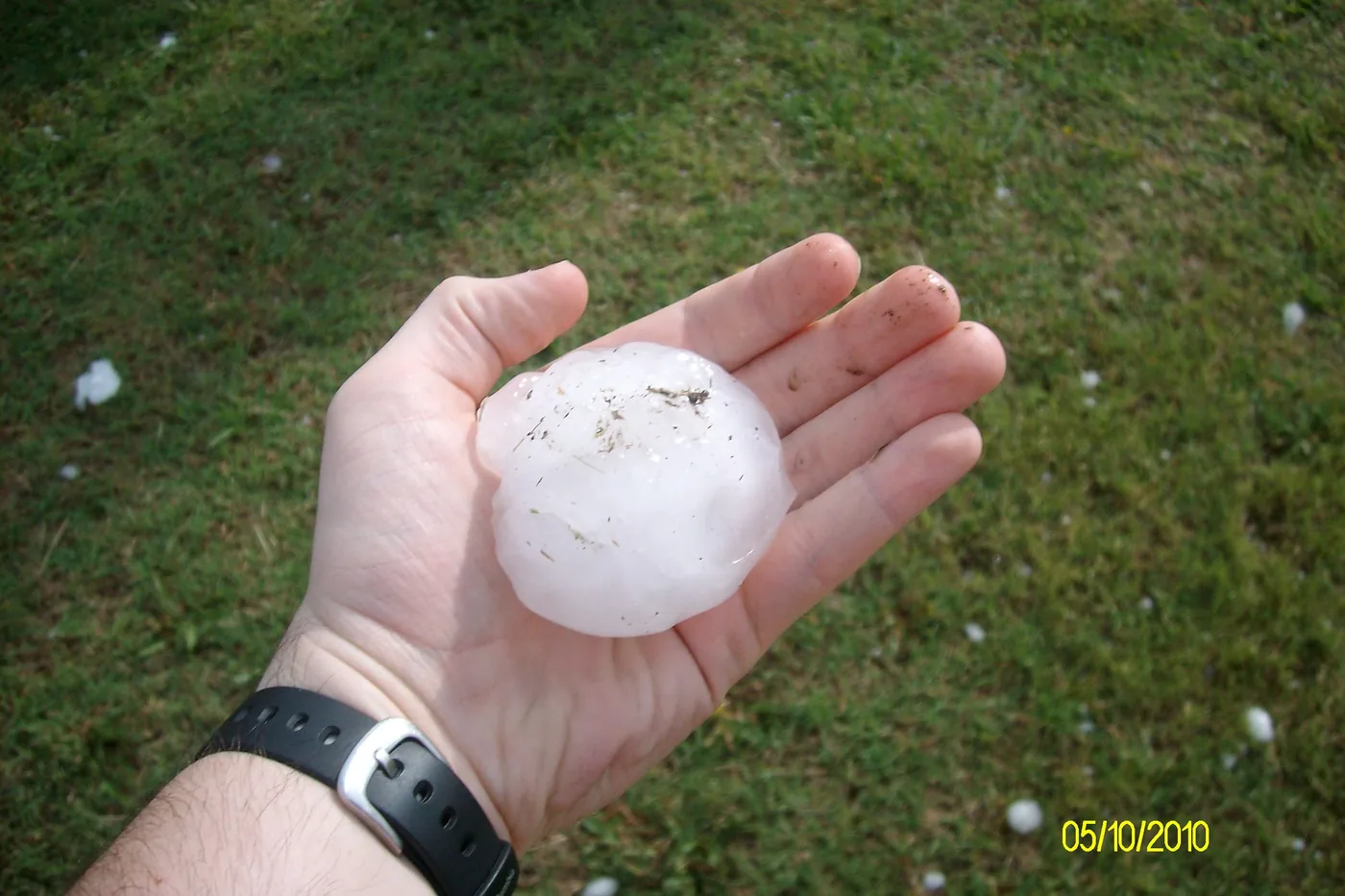
Damage-threshold ranges in this article are general guidance synthesized from industry and federal research — IBHS building-performance research, NWS severe criteria, and product standards such as UL 2218 (hail impact resistance) and ASTM D3161/D7158 (shingle wind ratings). Actual performance depends on product rating, age, installation quality, exposure, and impact characteristics — thresholds describe when damage becomes possible, not when it occurs.
Hail size charts match a stone to an everyday object: pea is 0.25 in., quarter 1.00 in., golf ball 1.75 in., softball 4.50 in. Asphalt shingles in typical condition often begin showing functional damage around 1.00 to 1.25 in. The chart below gives each size with its typical roof and window damage.
A hail size chart matches a hailstone to an everyday object of the same diameter, from a pea (0.25 in.) to a softball (4.50 in.). The chart below uses the National Weather Service size names and the same sizes and damage notes as StormAuditor's Hail Size Guide, which draws each size true to scale.
NWS hail size chart with typical roof damage
| Hail size | Inches | mm | NWS class (Hail Size Guide) | Roof, typical | Windows and skylights, typical |
|---|---|---|---|---|---|
| Pea | 0.25 | 6 | Sub-severe | No damage expected | No damage expected |
| Marble / Mothball | 0.50 | 13 | Sub-severe | No damage expected | No damage expected |
| Penny | 0.75 | 19 | Sub-severe (approaches severe) | Possible granule loss on aged or brittle asphalt shingles | Typically no damage |
| Nickel | 0.88 | 22 | Sub-severe | Possible granule loss on aged asphalt shingles | Typically no damage |
| Quarter | 1.00 | 25 | Severe (NWS threshold) | Possible shingle bruising or granule loss on aged asphalt roofs | Typically no damage |
| Half Dollar | 1.25 | 32 | Severe | Possible shingle bruising on many asphalt roofs | Cracks possible on aged or single-pane glass |
| Ping-Pong Ball | 1.50 | 38 | Severe | Possible shingle fractures on aged asphalt roofs | Possible cracked windows or damaged skylights |
| Golf Ball | 1.75 | 44 | Severe | Shingle fractures possible on many roofs | Possible cracked or broken windows and skylights |
| Hen Egg | 2.00 | 51 | Significant severe (NWS threshold) | Shingle fractures possible on most asphalt roofs | Broken windows or skylights possible |
| Tennis Ball | 2.50 | 64 | Significant severe | Possible deck exposure on aged roofs | Broken windows or skylights possible |
| Baseball | 2.75 | 70 | Significant severe | Possible roof-deck penetration on vulnerable roofs | Broken windows or skylights possible |
| Tea Cup | 3.00 | 76 | Significant severe (extreme) | Possible structural roof penetration on aged roofs | Broken windows and skylights possible |
| Grapefruit | 4.00 | 102 | Significant severe (extreme) | Structural roof penetration possible | Broken windows and destroyed skylights possible |
| Softball | 4.50 | 114 | Significant severe (extreme) | Structural roof penetration possible; hazard to anything outdoors | Widespread breakage possible |
The damage columns describe roofs and windows in typical condition. Sizes follow the NWS hail size descriptors used by NWS offices such as Binghamton (grapefruit 4.00 in., softball 4.50 in.). The Storm Prediction Center's conversion table swaps those two names, so the diameter in inches is what counts.
How to read the chart
Measure the largest stone, or compare it with a coin or ball of known size, and read across the row. Spotters report hail the same way, which is why Local Storm Reports often list sizes such as 1.00 in. (quarter) or 1.75 in. (golf ball).
Three rows anchor the chart:
- 0.75 in. (penny): StormAuditor's screening threshold for estimated hail at an address. It is a StormAuditor threshold, not an NWS criterion.
- 1.00 in. (quarter): the National Weather Service severe thunderstorm criterion for hail.
- 2.00 in. (hen egg): the size the Storm Prediction Center counts as significant severe hail.
What changes the damage at a given size
- Age and condition. Aged, brittle asphalt shingles can be damaged by smaller hail than new ones.
- Impact rating. Shingles rated under UL 2218 are tested with steel balls from 1.25 in. (Class 1) to 2 in. (Class 4). Class 4 products resist larger stones.
- Material. Metal roofs can dent from hail too small to fracture an asphalt shingle. A dent that does not let water in is cosmetic, and some policies exclude cosmetic damage.
- Wind and density. Wind drives hail at an angle, so slopes, siding and windows facing the storm take the most hits. Many stones in a short time do more damage than a few.
Find the hail size at your address
- Free Report Snapshot. The Free Report Snapshot answers YES or NO: does the public record show estimated hail of 0.75 in. or larger at the address in the last five years?
- Every hail date. A Hail Report (the $2.99 Single Weather Report) lists every qualifying storm date at the property with the estimated maximum hail size.
- One date, full evidence. The Audit Report shows the radar hail size at the property, the ground reports filed nearby, and how the estimate was reached.
StormAuditor's estimate is the radar (MRMS MESH) value in the grid cell that contains the property; a ground report within 1 mile can set a higher value. The hail methodology has the full rule.
Limitations
- Spotter sizes are often estimated by comparison with objects, and hail size can change sharply over short distances.
- Radar hail (MESH) is an estimate on a grid of about 1 km, not a measurement at the roof.
- Whether hail damaged a specific roof is decided by inspection. See Limitations.
Frequently asked questions
What size hail damages a roof?
Asphalt shingles in typical condition often begin showing functional damage around 1.00 to 1.25 in. hail, quarter to half-dollar size. Aged or brittle shingles can be damaged by smaller hail, and impact-rated (UL 2218 Class 4) shingles resist larger stones.
How do I read a hail size chart?
Measure the largest hailstone, or match it to the object of the same size, and read across that row for the diameter in inches and the typical damage at that size.
What hail size does the NWS call severe?
The National Weather Service severe thunderstorm criterion for hail is 1.00 in. (quarter size) or larger. The Storm Prediction Center counts 2.00 in. (hen egg) or larger as significant severe hail.
What is the difference between functional and cosmetic damage to a metal roof?
Functional damage stops the roof from shedding water, through punctures, cracked seams or broken fasteners. Cosmetic damage, such as dents, changes how the roof looks without letting water in.
Can StormAuditor show the hail sizes at my address?
Yes. The Free Report Snapshot gives a YES or NO for estimated hail of 0.75 in. or larger at the address, and a Hail Report lists every qualifying storm date at the property with the estimated maximum hail size. On Pro+ plans, the Hail Explorer maps radar hail swaths statewide by date.
Does wind change how much damage hail does?
Yes. Wind drives hail at an angle, so the slopes, siding and windows facing the storm take more and harder hits than the sheltered side.