What Is a Microburst? How Downbursts Damage Property
By StormAuditor Editorial Team · Published 2026-08-31 · Updated 2026-10-07
Based on public NOAA and National Weather Service records, published under StormAuditor's methodology and data-source standards. Radar-derived hail sizes are estimates unless attributed to a ground report.
Damage-threshold ranges in this article are general guidance synthesized from industry and federal research — IBHS building-performance research, NWS severe criteria, and product standards such as UL 2218 (hail impact resistance) and ASTM D3161/D7158 (shingle wind ratings). Actual performance depends on product rating, age, installation quality, exposure, and impact characteristics — thresholds describe when damage becomes possible, not when it occurs.
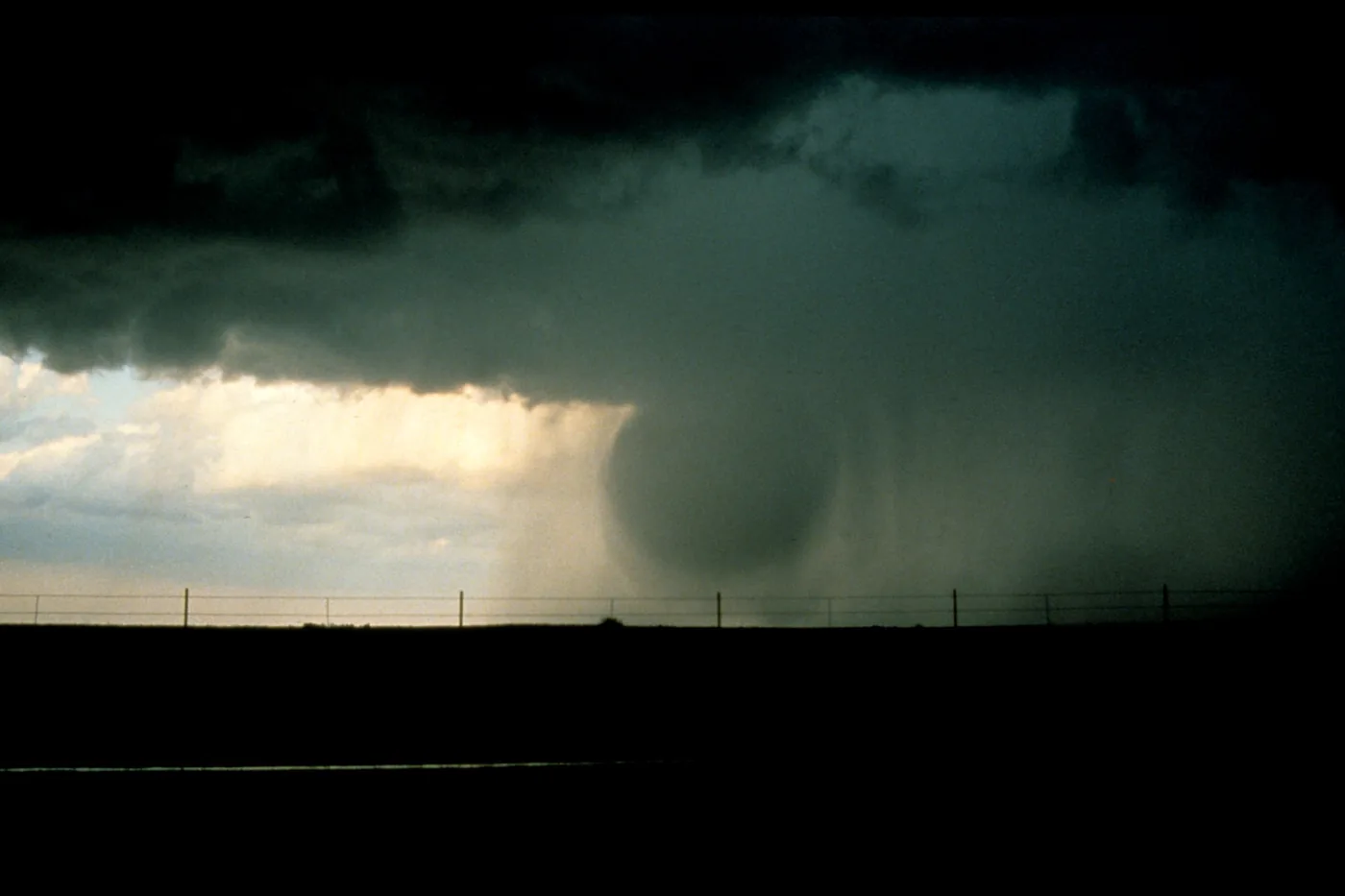
A microburst is a concentrated thunderstorm downdraft that hits the ground and fans out, producing straight-line winds that can rival a tornado over a small area. This guide explains how they form, what the damage looks like, and how owners and claim researchers can trace one in the public weather record.
A homeowner steps outside after a five-minute storm. Half the shingles from one roof slope sit in the yard. The fence lies flat, every panel pushed the same direction. Across the street, a neighbor's house looks untouched. No tornado warning was issued, and no funnel was seen. That combination — intense, localized, one-directional wind damage from a brief storm — is the classic signature of a microburst.
What a microburst is
Put simply, a microburst is a concentrated downdraft of air from a thunderstorm that slams into the ground and spreads outward. Meteorologists classify it as a downburst with a small footprint. The physics are simple. Rain and melting hail cool the air inside a storm. Cool air is dense and heavy. When that column collapses, it accelerates toward the surface like water poured from a bucket.
On impact, the wind fans out horizontally in every direction. Speeds near the center can rival many tornadoes. The National Weather Service classifies a thunderstorm as severe when gusts reach 58 mph, and plenty of microbursts meet or exceed that criterion. The strongest reach 75 mph or more, the level the Storm Prediction Center counts as significant severe wind.
Two varieties exist. A wet microburst arrives inside a curtain of heavy rain, which is common in humid climates. A dry microburst falls from a high-based storm with little rain reaching the ground. In that case the wind seems to come out of nowhere, sometimes under a mostly bright sky.
Why the damage looks the way it does
Microburst damage is straight-line wind damage. Fallen trees and scattered debris tend to point outward from a central spot, or in one dominant direction. A tornado leaves the opposite pattern — convergent and twisted. NWS survey teams use exactly this distinction when they classify a damage event after the fact.
For property, the mechanics matter:
- Roofs. Wind flowing over a roof creates uplift, the same effect that lifts an airplane wing. Gusts can crease shingle tabs, break adhesive seals, and peel back ridge caps. Damage often concentrates on the slope facing the wind.
- Fences and outbuildings. Flat fence panels act as sails. Lightly anchored sheds, carports, and screen enclosures are frequent casualties.
- Trees. Downburst winds can snap trunks or uproot healthy trees. Falling limbs account for much of the costly structural and vehicle damage.
- Siding, gutters, and windows. Wind-driven debris strikes one exposure of a building hardest. That asymmetry is a useful clue about wind direction.
Because the footprint is small, the contrast can be stark. One block takes heavy damage while homes a few streets away see only rain. This patchiness is why neighbors, adjusters, and even weather records can seem to disagree about the same afternoon.
How StormAuditor estimates it
StormAuditor's wind engine, SAWE-2, starts from the NWS analysis of record (URMA) and corrects it with measured station gusts and measured public storm reports to produce an address-level estimate of peak gusts.
Microbursts are a hard case because they are brief and narrow, which is exactly why cross-checking several datasets matters. The full approach is described in the wind methodology, with the hail counterpart in the hail methodology. Every output is an estimate of the public weather record — not a measurement taken at your roofline.
Practical guidance for owners and claim researchers
Start with the date. If you know roughly when the damage appeared, date-of-loss weather research can narrow the candidate storm days for a specific address. Microbursts rarely make the news, so the date often has to come from photos, texts, or a neighbor's memory.
Photograph conditions before repairs begin. Capture the direction fences fell, which roof slopes lost shingles, and where debris landed. Direction is evidence in a straight-line wind event.
Check the public record next. NWS local storm reports and the Storm Events Database record measured gusts, spotter reports, and damage descriptions for each county and day. A microburst may appear there as a "thunderstorm wind" entry rather than anything labeled microburst.
Then look at address-level estimates. The Free Report Snapshot screens an address at 45 mph, below the NWS severe criterion of 58 mph, so brief downburst events are less likely to slip past. A StormAuditor Wind Report then lists every date since October 2021 with an estimated gust of 40 mph or more at the property.
One caution for claim researchers: weather estimates describe conditions, not outcomes. An adjuster or engineer draws the conclusions about what happened to a particular roof. Good weather research supports that conversation; it does not replace it.
Related guide: Straight-Line Wind vs Microburst vs Tornado compares the three damage patterns and how NWS surveys label them.
Limitations
Microbursts push every wind dataset to its edge. Official anemometers sit miles apart, and a narrow downburst can pass between them without touching one. Model analyses smooth over small-scale peaks, so a real gust at one address can exceed the estimated value — or fall short of it.
Any estimate for a property is exactly that: an estimate, with uncertainty that grows as events get smaller and briefer. Read more about what these numbers can and cannot say on the Limitations page.
FAQ
Is a microburst the same as a tornado?
No. A tornado is rotating, rising air. A microburst is sinking air that spreads out on impact. The damage patterns differ too: outward or one-directional for a microburst, convergent and twisted for a tornado.
How strong can microburst winds get?
Strong enough to meet the NWS severe gust criterion of 58 mph, and often well beyond it. Some reach 75 mph or more, the level the Storm Prediction Center counts as significant severe wind, which can damage well-built structures.
Does insurance cover microburst damage?
Wind is a commonly covered peril in standard property policies. Coverage in any specific case depends on the policy language, the deductible, and the adjuster's findings. Weather data can support the date and conditions; it cannot decide the claim.
Why was there no warning before my microburst?
They form fast. An ordinary-looking storm can produce a damaging downburst within minutes, sometimes before a warning is practical. A missing warning does not mean nothing happened — the public record may still hold reports for that day.
What does microburst roof damage look like?
Creased, lifted, or missing shingles concentrated on one or two slopes, often with bent ridge caps and displaced gutters. Damage on the windward exposure with a clean opposite side is typical of straight-line wind.