What Size Hail Damages a Roof? Size by Size
By StormAuditor Editorial Team · Published 2026-07-14 · Updated 2026-10-07
Based on public NOAA and National Weather Service records, published under StormAuditor's methodology and data-source standards. Radar-derived hail sizes are estimates unless attributed to a ground report.
Damage-threshold ranges in this article are general guidance synthesized from industry and federal research — IBHS building-performance research, NWS severe criteria, and product standards such as UL 2218 (hail impact resistance) and ASTM D3161/D7158 (shingle wind ratings). Actual performance depends on product rating, age, installation quality, exposure, and impact characteristics — thresholds describe when damage becomes possible, not when it occurs.
Hail around 1.00 to 1.25 inches (quarter to half-dollar size) is where asphalt shingles in typical condition often begin showing functional damage. Older, brittle shingles can be damaged by smaller hail; impact-rated shingles resist larger stones. Check which hail sizes the public record shows at your address before you file.
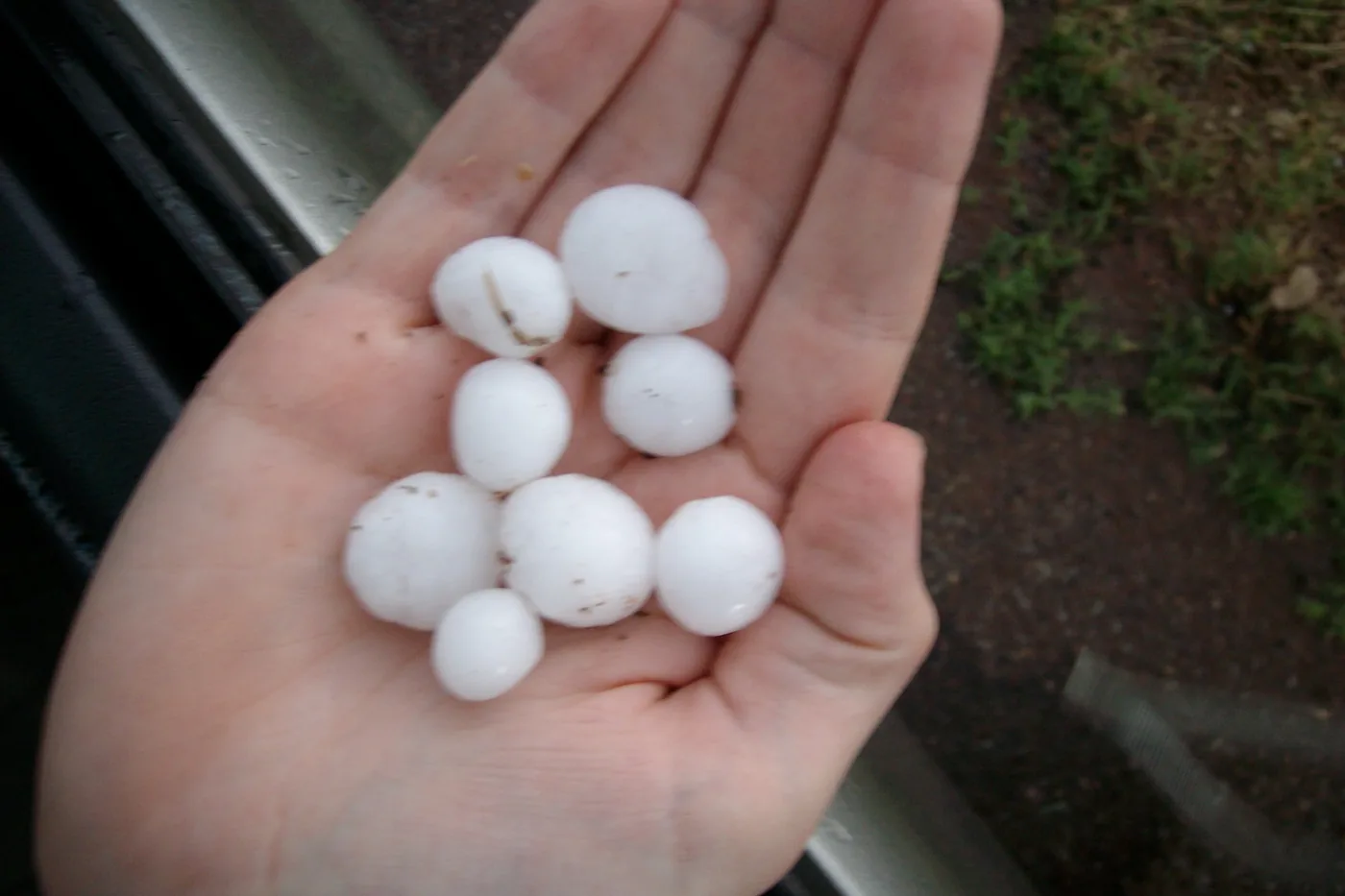
The table below goes size by size, from pea to softball, with what each size can do to a roof in typical condition. For a true-to-scale hail size chart, use the free Hail Size Guide; to see which sizes fell at your address, start with the Free Report Snapshot or a Hail Report.
Hail size and roof damage, size by size
| Hail size | Inches | mm | What it can do to a roof (typical) |
|---|---|---|---|
| Pea | 0.25 | 6 | No damage expected |
| Marble / Mothball | 0.50 | 13 | No damage expected |
| Penny | 0.75 | 19 | Possible granule loss on aged or brittle asphalt shingles |
| Nickel | 0.88 | 22 | Possible granule loss on aged asphalt shingles |
| Quarter | 1.00 | 25 | Possible shingle bruising or granule loss on aged asphalt roofs |
| Half Dollar | 1.25 | 32 | Possible shingle bruising on many asphalt roofs |
| Ping-Pong Ball | 1.50 | 38 | Possible shingle fractures on aged asphalt roofs |
| Golf Ball | 1.75 | 44 | Shingle fractures possible on many roofs |
| Hen Egg | 2.00 | 51 | Shingle fractures possible on most asphalt roofs |
| Tennis Ball | 2.50 | 64 | Possible deck exposure on aged roofs |
| Baseball | 2.75 | 70 | Possible roof-deck penetration on vulnerable roofs |
| Tea Cup | 3.00 | 76 | Possible structural roof penetration on aged roofs |
| Grapefruit | 4.00 | 102 | Structural roof penetration possible |
| Softball | 4.50 | 114 | Structural roof penetration possible; hazard to anything outdoors |
Three sizes anchor the scale:
- 0.75 in. (penny): StormAuditor's screening threshold for estimated hail at an address.
- 1.00 in. (quarter): the National Weather Service severe thunderstorm criterion for hail (NWS severe weather definitions). The NWS raised it from 0.75 in. nationwide in January 2010.
- 2.00 in. (hen egg): the size the Storm Prediction Center counts as significant severe hail.
What moves the damage threshold
The same stone can bruise one roof and leave the next one unmarked. These factors decide where a roof falls in the ranges above:
- Age and condition. Aged, brittle asphalt shingles can be damaged by smaller hail than new ones.
- Impact rating. Impact-rated shingles are tested under UL 2218, which drops steel balls from 1.25 in. (Class 1) up to 2 in. (Class 4) across. Class 4 products resist larger stones.
- Roof material. Metal roofs can dent from hail too small to fracture an asphalt shingle. A dent that does not let water in is cosmetic, and some policies exclude cosmetic damage.
- Density and wind. Many stones in a short time do more damage than a few, and wind-driven hail hits the slopes and siding facing the storm hardest.
How hail forms
Hailstones form when thunderstorm updrafts carry raindrops high into air far below freezing. The drops freeze, fall, and are caught by the updraft again, adding layers of ice on each trip. The stronger the updraft, the larger the stones it can hold up before they fall.
How hail size is reported
- Ground reports. Spotters, NWS staff, and the public report hail by comparing it with common objects or by measuring it with a ruler. The NWS logs these as Local Storm Reports, and they appear in SPC Storm Reports and later in the NCEI Storm Events Database.
- Radar estimates. NOAA's MRMS system computes MESH (Maximum Estimated Size of Hail), an estimate of the largest hail at the ground on a grid of about 1 km, calibrated against ground reports. The MESH explainer covers how to read it.
Ground reports give a size at one point and time; radar covers every address. StormAuditor's hail methodology explains how the two are combined.
How to check the hail size at your address
- Run the Free Report Snapshot. The Free Report Snapshot answers YES or NO: does the public record show estimated hail of 0.75 in. or larger at the address?
- Get every hail date. A Hail Report (the $2.99 Single Weather Report) lists every date since October 2021 with estimated hail of 0.50 in. or larger or an estimated gust of 40 mph or more at the property, with the estimated maximum hail size for each.
- Document one date. The Audit Report shows the radar hail size at the property and the largest within 1, 3, and 10 miles, the ground reports filed nearby, and how the estimate was reached.
The Hail Explorer (Pro+ plans) maps radar hail swaths statewide by date.
Limitations
- Ground reports are point observations, and many sizes are estimated by comparison with common objects. Hail size can change sharply over short distances, and sparsely populated areas get fewer reports.
- MESH is a radar estimate on a grid of about 1 km, not a measurement at the property; its published skill is by size category rather than exact size.
- Whether hail of a given size damaged a specific roof is decided by inspection. See Limitations.
Frequently asked questions
What size hail damages a roof?
Asphalt shingles in typical condition often begin showing functional damage around 1.00 to 1.25 in. hail, quarter to half-dollar size. Aged or brittle shingles can be damaged by smaller hail, and impact-rated (UL 2218 Class 4) shingles resist larger stones.
What is considered severe hail?
The National Weather Service defines severe hail as 1 inch (quarter size) or larger. The Storm Prediction Center counts hail of 2 inches or larger as significant severe.
How big is golf ball hail?
Golf ball hail is about 1.75 in. (44 mm) across. At that size, shingle fractures are possible on many roofs, along with dented siding, gutters, and vehicles.
Can pea-sized hail cause damage?
Pea-sized hail (0.25 in.) does not damage roofs. A long fall of small hail can strip plants and crops, pile up, and make roads slippery.
Does all hail fall straight down?
No. Wind inside and around a thunderstorm drives hail at an angle, so slopes, siding, and windows facing the storm take more hits than the sheltered side.
How can I find out the hail size at my property on a specific date?
Run the Free Report Snapshot for a quick YES or NO, then get a Hail Report listing each hail date at the address with the estimated size. An Audit Report shows the radar hail field and nearby ground reports for one date.
Check your address with the Free Report Snapshot, or get every hail date with a Hail Report.