Wind Damage to Roof: Signs, Wind Speeds, Storm Dates
By StormAuditor Editorial Team · Published 2026-10-06 · Updated 2026-10-07
Based on public NOAA and National Weather Service records, published under StormAuditor's methodology and data-source standards. Radar-derived hail sizes are estimates unless attributed to a ground report.
Damage-threshold ranges in this article are general guidance synthesized from industry and federal research — IBHS building-performance research, NWS severe criteria, and product standards such as UL 2218 (hail impact resistance) and ASTM D3161/D7158 (shingle wind ratings). Actual performance depends on product rating, age, installation quality, exposure, and impact characteristics — thresholds describe when damage becomes possible, not when it occurs.
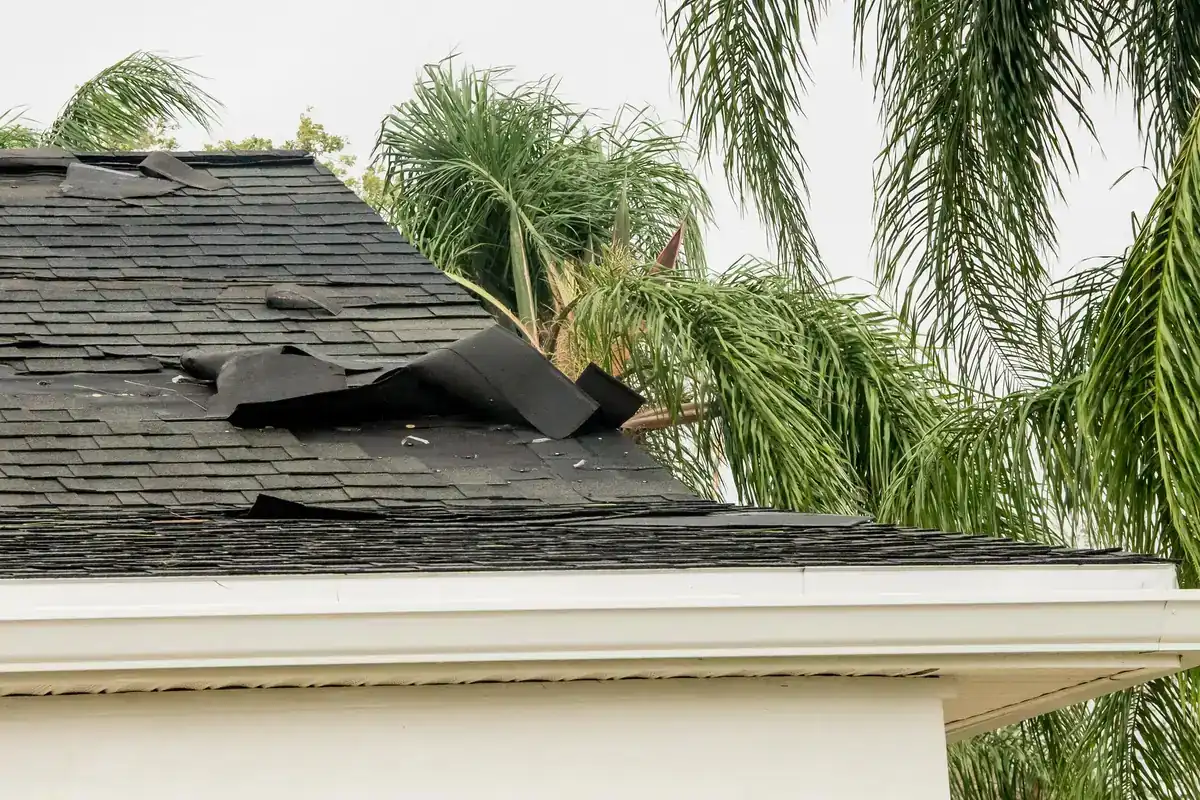
Wind damage to a roof shows up as creased, lifted, or missing shingle tabs, torn ridge caps, and peeled edges, mostly at roof edges and ridges. On aged roofs it can start with gusts of 46–57 mph, below the NWS severe level. Before you file, look up the estimated peak gust at your address on the storm date.
Wind damage to a roof is uplift damage: gusts pull shingles up and back instead of striking them from above. It shows as creased, lifted, or missing tabs, torn ridge caps, and peeled edges, and it starts at the roof perimeter. This guide covers the signs, the gust speeds usually involved, what shingle wind ratings mean, and how to check the wind at your address on the storm date.
What wind damage to a roof looks like
Look for these signs from the ground first, then up close with a qualified roofer:
- Creased tabs. A tab that lifted and folded back leaves a horizontal crease, usually near the nail line. The tab may lie flat again, so the crease is often the only clue.
- Broken seal strips. The adhesive strip between courses lets go and the tab lifts freely by hand. Dirt or grit stuck to the old sealant shows the bond broke some time ago.
- Missing tabs or whole shingles. Torn material at the nails, exposed nail heads, and bare underlayment or felt.
- Ridge and hip caps. Caps are exposed on both sides, so they are often the first pieces lifted or blown off.
- Edges and rakes. Starter courses, drip edge, and rake shingles peel back where the wind gets underneath.
- Flashing and vents. Bent or lifted flashing around chimneys and walls, and loose vent caps or turbine vents.
- Debris downwind. Shingle pieces in the yard, gutters, or a neighbor's lot, lying in the direction the wind blew.
Damage that lines up with one wind direction, on several houses along a street, points to a wind event. Damage scattered at random across every slope, with round marks and dented gutters, points to hail instead.
Where on the roof wind damage starts
Uplift pressure is highest at corners, eaves, rakes, and ridges, so wind damage begins there and works inward as gusts get stronger. Slopes facing the wind usually take the most damage. A roof with a few lifted tabs along one rake after a storm is the classic early wind pattern.
Age and installation change where a roof gives way. Shingles that never sealed, high nailing, and brittle, aged material let tabs lift at lower speeds than a new, well-sealed roof. Trees add a second path: limbs that break in the same gusts can puncture a roof that the wind alone would not have damaged.
What wind speeds damage a roof?
There is no single number: roof age, condition, product rating, and installation move it. The bands below are the same ones StormAuditor's Wind Speed Guide uses.
| Peak gust | What it can do to a roof (typical) |
|---|---|
| Up to 30 mph | Typically no damage |
| 31–45 mph | Possible flutter of already-loose shingles on aged roofs |
| 46–57 mph | Shingles may lift on aged or poorly-fastened roofs |
| 58–73 mph | Possible shingle loss on aged or poorly-fastened roofs; 58 mph is the NWS severe thunderstorm criterion |
| 74–95 mph | Possible widespread shingle or roof-covering loss |
| 96–110 mph | Possible roof-deck loss on vulnerable structures |
| 111–129 mph | Roof-deck loss possible |
| 130–156 mph | Roof-structure failure possible |
| 157 mph and up | Structural failure possible |
Two reference points help when you read a weather report. StormAuditor's screening threshold for wind is 45 mph: below the NWS severe level on purpose, because aged roofs can lift below 58 mph. The National Weather Service defines a severe thunderstorm as one producing gusts of at least 58 mph or hail at least 1 inch across (NWS severe weather definitions).
Gusts, not sustained winds, do most roof damage. A gust is a brief peak lasting seconds; sustained wind is an average over a minute or two. The Wind Gust vs. Sustained Wind article explains the difference.
Shingle wind ratings: ASTM D3161 and D7158 classes
Asphalt shingle packages list one or both of two ASTM wind ratings:
| Standard | Class | Wind speed behind the class |
|---|---|---|
| ASTM D3161 (fan test) | Class A | 60 mph test speed |
| ASTM D3161 (fan test) | Class D | 90 mph test speed |
| ASTM D3161 (fan test) | Class F | 110 mph test speed |
| ASTM D7158 (uplift method) | Class D | 115 mph design wind speed |
| ASTM D7158 (uplift method) | Class G | 150 mph design wind speed |
| ASTM D7158 (uplift method) | Class H | 190 mph design wind speed |
ASTM D3161 blows air from a fan across a test deck of sealed shingles; the class is the highest fan speed the shingles pass. ASTM D7158 measures how hard it is to lift a sealed shingle and compares that with the uplift calculated for a design wind speed under ASCE 7 assumptions.
The D7158 speeds follow the ASCE 7 edition the standard references. NRCA's Professional Roofing magazine (September 2018) lists Class D, G, and H at 115, 150, and 190 mph ultimate design wind speeds under the ASCE 7-10 basis, up from 90, 120, and 150 mph in the original 2005 edition. Older shingle packages may still print the earlier numbers.
A rating does not translate one-to-one into the gust a roof can take on a given day:
- Ratings are earned by new, fully sealed shingles under test conditions. Aging, unsealed tabs, and installation errors lower real performance.
- D7158 classes assume conditions that the standard spells out, such as roof height and terrain exposure; a hilltop or open-shoreline house sees more wind than a sheltered one.
- Ridge caps, starter strips, and flashing have their own weak points that the shingle rating does not cover.
Use the rating to understand what the roof was built for, and the weather record to see what it actually faced.
How to check the wind on your storm date
Knowing the date and the wind at your address turns "it was windy" into a record you can attach to a claim. Here is the order that works:
- Run the Free Report Snapshot. The Free Report Snapshot answers YES or NO: does the public record show an estimated gust of 45 mph or more, or hail of 0.75 in. or larger, at the address? Free with an account.
- Get the list of dates. A Wind Report (the $2.99 Single Weather Report) lists every date in the last two years with an estimated gust of 40 mph or more or hail of 0.50 in. or larger at the property, each with its estimated peak gust.
- Look at measured gusts nearby. The Storm Map shows station peak gusts, storm reports, and warnings by day. Airport ASOS stations log a peak wind remark with the time of the reading, per the NWS ASOS User's Guide.
- Document one date in full. The Audit Report shows the evidence behind a single date's estimate: the instruments used, their distance from the property, rejected readings, and the arithmetic.
If you do not know the date, the Date of Loss Weather Research workflow narrows the candidate storm days first.
Wind damage vs. hail damage
Many storms bring both, so the pattern on the roof matters:
- Wind lifts and peels. Damage concentrates at edges, corners, and ridges, follows one direction, and includes creases and missing pieces.
- Hail strikes from above at random. It leaves round marks with granule loss, bruises, and dents in gutters, vents, and other soft metals across several slopes.
The Wind vs. Hail Damage on a Roof article covers look-alikes such as blistering and foot traffic. Check both estimates for your date: each Weather Report date carries an estimated peak gust and an estimated hail size.
Paperwork for a wind damage roof claim
Gather these before you call your insurer or let a contractor file for you:
- The date of loss and the approximate time, from photos, texts, or a neighbor's account.
- Photos of each damaged area, wide and close, before any repair. Include the direction fences or debris fell.
- The weather record for that date: the estimated peak gust at the address, measured station gusts nearby with distances and times, and any NWS warnings in effect.
- Roof details: age, shingle brand and wind rating if you have them, and past repair receipts.
- Temporary repair receipts for tarps or boarding, since most policies expect you to prevent further damage.
The Wind Damage Claim article walks through the claim itself, and Weather Data for a Roof Claim: What Adjusters Check covers how the weather section is reviewed.
Limitations
An estimated gust is the wind the public record supports at the property coordinates; it is not a measurement taken on your roof. Wind estimates at an address cover the last two years. Whether the wind damaged a specific roof is decided by inspection. See Limitations and the wind methodology.
Frequently asked questions
What wind speed can damage a roof?
Aged or poorly fastened asphalt shingles can lift with gusts in the 46–57 mph range. Shingle loss on aged roofs is possible from the NWS severe criterion of 58 mph, and widespread roof-covering loss is possible from about 74 mph. Roof age, condition, and wind rating move these ranges.
Are 60 mph winds enough to damage a roof?
They can be. Gusts near 60 mph are above the NWS severe thunderstorm criterion of 58 mph, and shingle loss is possible at that speed, especially on older roofs or shingles that never sealed. A newer roof rated ASTM D3161 Class F or D7158 Class H is built for much higher speeds.
What do ASTM D3161 Class F and D7158 Class H mean?
They are shingle wind ratings. D3161 Class F means the shingles passed a fan test at 110 mph. D7158 Class H is the highest D7158 class: the measured uplift resistance meets the calculated demand at the top design wind speed, 190 mph under the ASCE 7-10 basis (150 mph in the 2005 edition).
How do I find out how windy it was at my house?
Run the Free Report Snapshot for the address, then get a Wind Report for the estimated peak gust on each storm date. Compare it with measured station gusts on the Storm Map, and order an Audit Report for the evidence behind a single date.
Is wind damage to a roof covered by insurance?
Wind is a commonly covered peril in homeowners policies, but coverage depends on your policy language, deductible, and the adjuster's findings. StormAuditor documents the weather record; it does not decide coverage.
How can I tell wind damage from hail damage on a roof?
Wind damage follows one direction and concentrates at edges, corners, and ridges, with creased or missing tabs. Hail damage is random across several slopes, with round marks, granule loss, and dented soft metals.
Ready to check your date? Start with the Free Report Snapshot, or go straight to a Wind Report for every storm date at the address.