EF Scale Explained: How Tornado Damage is Rated
By StormAuditor Editorial Team · Published 2026-07-14 · Updated 2026-08-19
Based on public NOAA and National Weather Service records, published under StormAuditor's methodology and data-source standards. Radar-derived hail sizes are estimates unless attributed to a ground report.
Damage-threshold ranges in this article are general guidance synthesized from industry and federal research — IBHS building-performance research, NWS severe criteria, and product standards such as UL 2218 (hail impact resistance) and ASTM D3161/D7158 (shingle wind ratings). Actual performance depends on product rating, age, installation quality, exposure, and impact characteristics — thresholds describe when damage becomes possible, not when it occurs.
The Enhanced Fujita (EF) Scale rates tornadoes based on the damage they cause, providing a standardized way to assess their intensity. This scale is crucial for understanding the historical impact of tornado events.
Understanding the Enhanced Fujita (EF) Scale
The Enhanced Fujita (EF) Scale is the standard way to rate tornado strength in the United States. Direct wind readings are hard to get inside a tornado. So the EF Scale looks at how badly buildings and trees were damaged instead. From that damage, meteorologists and engineers estimate the tornado's winds and rate its strength.
What Is the EF Scale and How Does It Work?
Dr. T. Theodore Fujita introduced the original Fujita Scale (F Scale) in 1971. It was groundbreaking, but it had limits. It had trouble tying damage to specific wind speeds. It also did not account for differences in how well buildings were built. To fix this, the Enhanced Fujita (EF) Scale took effect in 2007.
The EF Scale rates a tornado with two tools:
- Damage Indicators (DIs): the kinds of things that get damaged. A house, for example, is one DI.
- Degrees of Damage (DoD): the stages of damage a DI can suffer, such as roof damage, collapsed outer walls, or a house wiped off its foundation.
Each DoD has an estimated wind speed range. This rates tornado strength more precisely and more consistently than the old F Scale.
The EF Scale runs from EF0 (weakest) to EF5 (strongest):
- EF0: Light damage (e.g., peels surface off some roofs; some gutters and siding removed; branches broken off trees; shallow-rooted trees pushed over.) Estimated winds: 65-85 mph.
- EF1: Moderate damage (e.g., roofs severely peeled; mobile homes overturned or badly damaged; loss of exterior doors; windows and other glass broken.) Estimated winds: 86-110 mph.
- EF2: Considerable damage (e.g., roofs torn off well-constructed houses; foundations of frame homes shifted; mobile homes completely destroyed; large trees snapped or uprooted; light-object missiles generated.) Estimated winds: 111-135 mph.
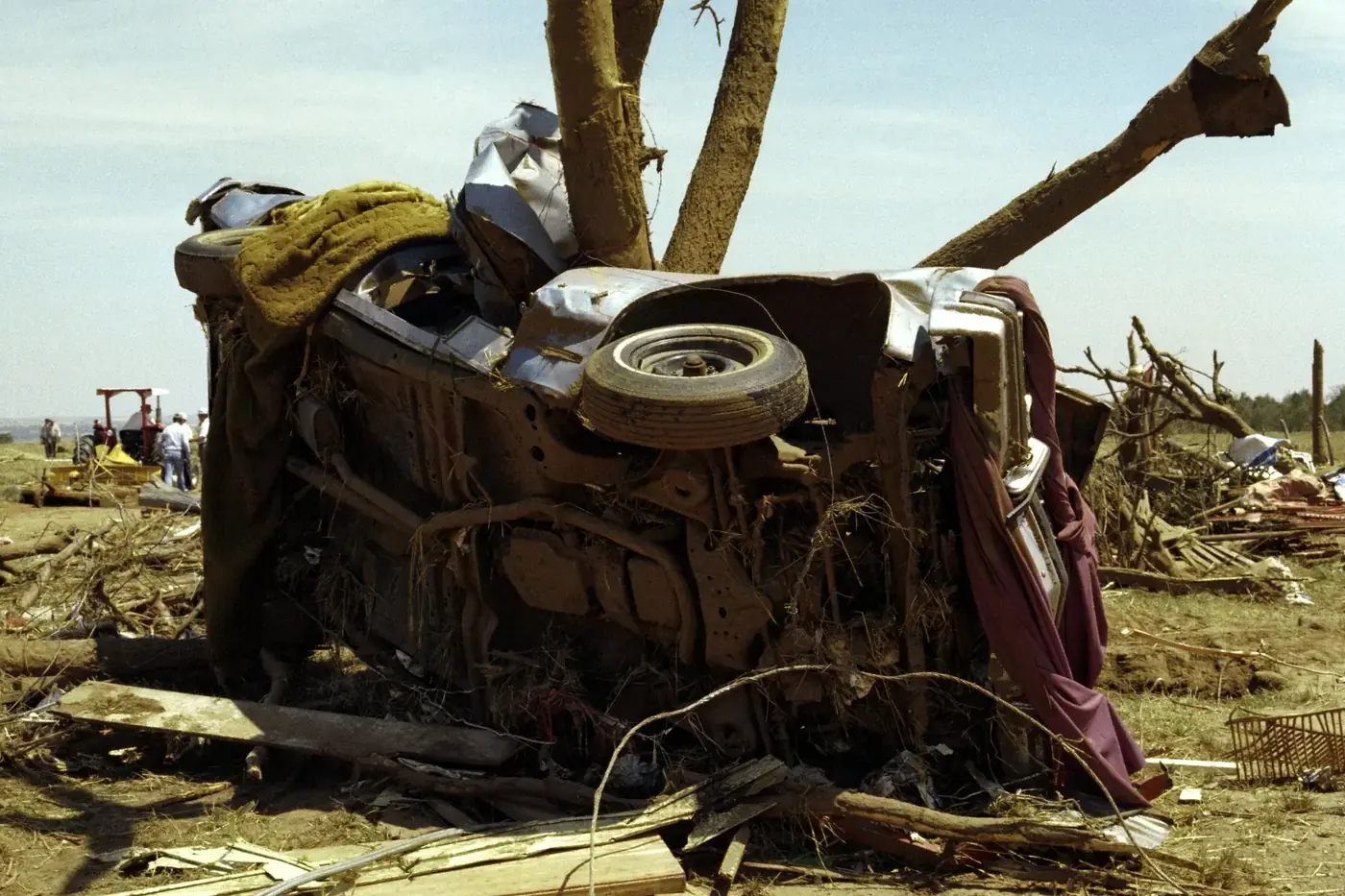
- EF3: Severe damage (e.g., entire stories of well-constructed houses destroyed; extensive damage to large buildings; trains overturned; trees debarked; heavy cars lifted off the ground and thrown.) Estimated winds: 136-165 mph.
- EF4: Devastating damage (e.g., well-constructed and whole frame houses completely leveled; cars thrown; small strong buildings or concrete structures partially destroyed.) Estimated winds: 166-200 mph.
- EF5: Incredible damage (e.g., strong frame houses leveled off foundations and swept away; automobile-sized missiles flown through the air over 100 meters; incredible phenomena will occur.) Estimated winds: Over 200 mph.
How StormAuditor Uses Tornado Data
StormAuditor draws on a large record of past tornadoes, including EF Scale ratings. This gives detailed insight into past weather at specific places.
- With StormAuditor's [/date-of-loss-weather-research] tool, we can check whether a tornado struck near your property on a given date, and its EF rating.
- Our reports include key details such as the tornado's path, strength, and any reported damage near you.
The EF Scale helps you read our tornado damage assessments. Say a property sat in the path of an EF2 tornado. Our research would then check whether the reported damage at the property matches what the EF Scale's damage indicators expect from a tornado that strong.
The EF Scale mainly estimates wind speed from damage. StormAuditor's reports often look at the wider impact. We track the official tornado path and reported damage zones. To learn how we gather and analyze this data, see our [/data-sources] and [/methodology/wind] sections.
Honest Limitations
The EF Scale has limits:
- The rating depends on the evidence left behind. That evidence can be sparse, mainly in rural or empty areas.
- The scale gives estimated wind speeds, not exact measurements.
- It assumes a certain building quality. A poorly built structure might show EF2 damage from EF0 winds, for example.
- We rely on official reports from agencies like the National Weather Service. Those reports have their own limits from field surveys and after-the-fact analysis.
StormAuditor does not decide whether a tornado caused a specific property's damage. We give the weather context for a place and date, including whether a tornado was present and how strong it was. Our reports help you understand the weather at the time of an incident.
Related StormAuditor Tools
- [/address-lookup]: Find weather history for an address fast.
- [/date-of-loss-weather-research]: Do full research for a date and location.
- [/wind]: Explore our wind event research tools.
- [/hail]: See how we research past hail.
- [/sample-report]: See an example StormAuditor report.
Frequently Asked Questions
Q: What's the difference between the F-Scale and the EF-Scale?
A: The F-Scale was the original tornado rating system, from 1971. The EF-Scale replaced it in 2007. The EF-Scale uses a more detailed set of damage indicators and degrees of damage. This improves wind speed estimates and accounts for differences in building quality.
Q: Can an EF0 tornado still cause significant property damage?
A: Yes. Even an EF0 tornado, with estimated winds of 65-85 mph, can cause real damage. Weaker structures, roofs, and trees are most at risk. The damage depends on the tornado itself and how vulnerable the property is.
Q: How are tornado ratings decided?
A: Meteorologists and engineers survey the damage after the storm. They look at damaged buildings and trees. They compare what they see with the EF Scale's Damage Indicators and Degrees of Damage. From that, they assign an estimated strength rating.
Q: Does StormAuditor give the exact wind speed that hit my property during a tornado?
A: StormAuditor reports the NWS's official EF-Scale rating and its estimated wind speed range for tornadoes surveyed near your property. That rating describes the tornado as a whole. It is not a measured wind speed at your address, and no service can give one for every spot along a tornado's path.
Q: How reliable is the EF Scale for past events?
A: The EF Scale is the most reliable system available for estimating tornado strength from damage after the fact. Its reliability depends on how much good damage evidence there is. That can vary, mainly for very old events or those in thinly populated areas. StormAuditor relies on official NWS reports, which use the EF Scale for their surveys.